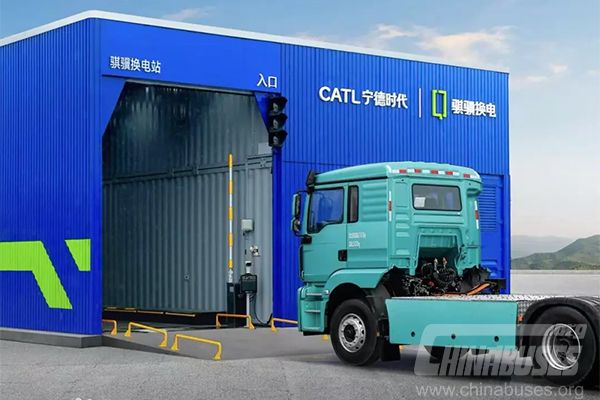
Qiji Battery-Swap Exceeds Annual Station-Building Target: 305 Stations Built in One Year
05 January 2026
On December 29, the 300th Qiji battery-swap station—Xiaoshan Transfar Station on the East China–South China trunk line—was officially completed. In 2025, Qiji Battery-Swap built a total of 305 stations nationwide, surpassing its annual goal of “300 stations within one year.” It has preliminarily formed a “two-horizontal, two-vertical” trunk-line swapping corridor and 14 key regional networks, with a total national green-swap network length of 78,000 km. This milestone not only sets a new infrastructure speed record in the heavy-duty truck battery-swap sector, but also marks several key breakthroughs in large-scale deployment, injecting strong momentum into the electrification transition of heavy-duty trucks.
On the expressway trunk-line front, Qiji has already covered key nodes along two east–west horizontal corridors (G42 Shanghai–Chengdu and G60 Shanghai–Kunming) and two north–south vertical corridors (G2 Beijing–Shanghai and G4 Beijing–Hong Kong–Macau), preliminarily establishing a battery-swap service system along the nation’s main arterial highways. It has also successfully created two demonstration long-distance swap routes: Chengdu–Wuhan and Shanghai–Guangzhou.
In terms of key regional networking, Qiji Battery-Swap has landed in 26 provinces, forming an initial nationwide network covering China’s major economic zones. East China uses Shanghai as the core hub to achieve multi-station coordination, with the Yangtze River Delta networking project advancing steadily; South China leverages Guangdong as a pivot to strengthen deployment, and Hainan Free Trade Port has achieved basic island-wide network coverage; the first batch of stations in Southwest China is now operating, covering key routes such as G5 Beijing–Kunming and G42 Shanghai–Chengdu, and the high-altitude “Zero-Carbon Sky Road” project has been launched in western Sichuan, while the first cross-border heavy-duty truck battery-swap trunk line from Yunnan via Panzhihua to the Mohan border port has been opened; the western Ningxia–Shaanxi–Inner Mongolia networking project penetrates deep into energy and logistics hinterlands; North China steadily expands across the four “mountain–river” provinces, providing strong support for the electrification transition of resource-based regions.
Public data shows that the industry previously took more than four years to build 300 battery-swap stations, whereas Qiji achieved the same scale in just one year, creating a new speed record for heavy-duty truck battery-swap network construction.
On industrial collaboration, Qiji Battery-Swap has continuously deepened strategic cooperation with OEMs such as FAW Jiefang and Shaanxi Heavy Duty Truck, jointly launching over 30 standardized battery-swap vehicle models; it has reached partnerships with leading logistics companies including JD Logistics, Transfar Logistics, and DHL to promote the battery-swap model across diverse scenarios; Karl Future Transport Robots + Qiji Battery-Swap will enter the trillion-yuan autonomous-driving market; the first cooperative station with Sinopec has been put into operation in Fuqing, Fujian; it has established strategic cooperation with more than 30 highway and transportation investment companies nationwide—such as Chongqing Expressway, Gan-Yue Expressway, Henan Communications Investment, and Jinhua Communications Investment—to jointly deploy new heavy-duty truck battery-swap infrastructure. Of the 305 stations built this year, 92 were co-constructed with partners, demonstrating significant results from ecosystem co-building.
Regarding standards and technology, in 2025 Qiji Battery-Swap participated in and helped to officially release Shanxi Province’s provincial-level standard for heavy-duty truck battery-swap, while Shenzhen’s relevant local standard was also launched. On technology integration, Qiji and Karl Power jointly created the world’s first “zero-carbon unmanned freight corridor,” exploring an integrated intelligent solution of “autonomous driving + chassis battery-swap.”
Preliminary “Two-Horizontal, Two-Vertical” Trunk Swap Corridors Completed
Total length of the national green-swap network: 78,000 km
In 2026, Qiji Battery-Swap will continue to densify station deployment, planning to reach a cumulative total of 900 stations and expand trunk lines to “five-horizontal, five-vertical.” By 2030, Qiji aims to build a nationwide green-swap network of 180,000 km covering 80 % of trunk-line transport capacity in an “eight-horizontal, ten-vertical” pattern, supporting heavy-duty truck electrification, lowering logistics costs, improving efficiency, and contributing to the nation’s “dual-carbon” goals.
Source : www.chinabuses.org
Editor : Sissi
Views:107549