Decoding Golden Dragon GC Series: The Technology Behind a True All-Scenario Coach
17 November 2026
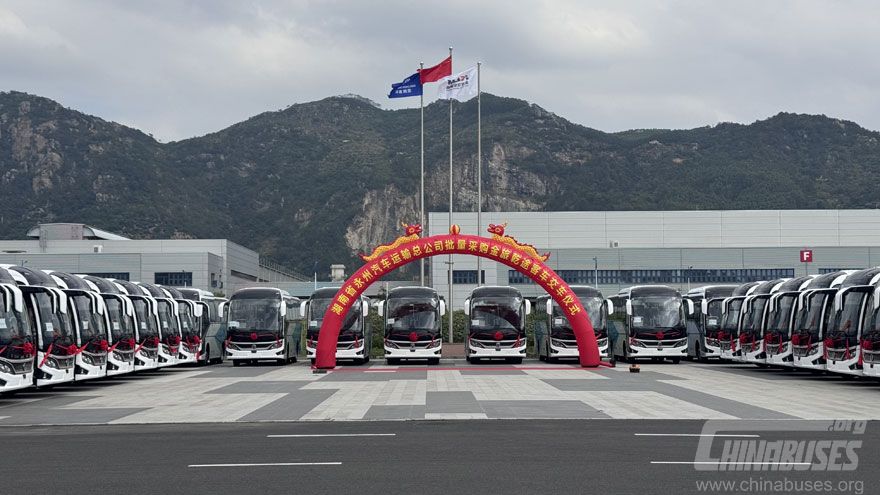
Golden Dragon's GC Series coach has recently completed a string of batch deliveries across multiple market segments in quick succession: 8.2-meter battery-electric models handed over to Hefei Public Transport Group's Yixing Transportation for corporate commuting and customized shuttle routes; 9-meter premium touring versions delivered in bulk to Yunnan Honghe Shunjie for cultural-tourism charters and scenic-area dedicated lines; and 12-meter models already earning their first customer endorsements on Tianjin Jinyihua's commuter routes. Launched only in July, how has this new premium coach won over the market so quickly?
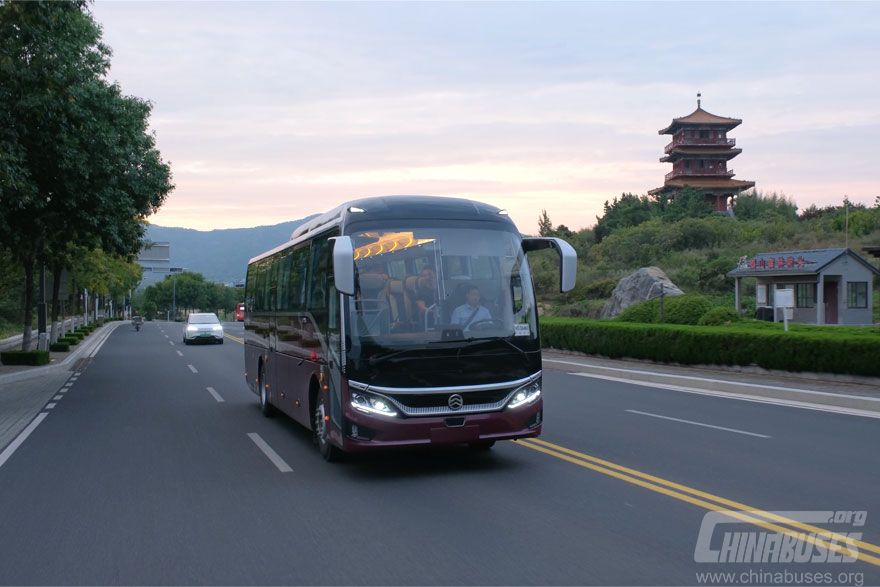
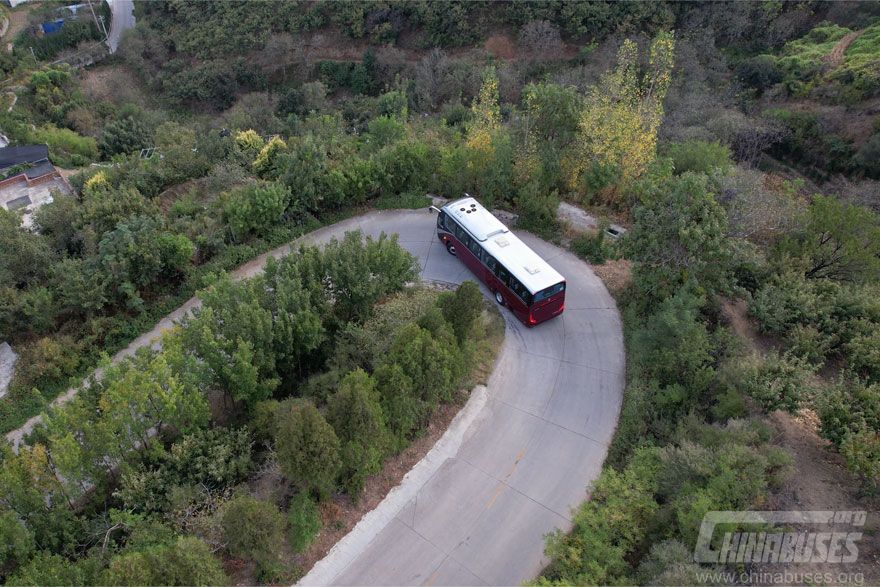
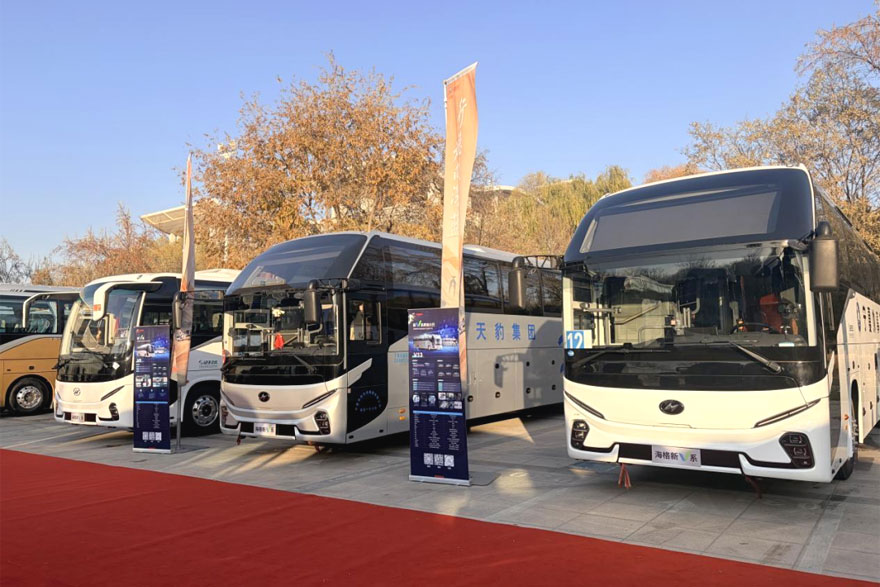
From battery-electric commuting to mountain-route tourism, from flatland intercity runs to highly corrosive coastal environments, the simultaneous deployment of one platform across such different scenarios speaks volumes about the GC Series' underlying product strength. It is not a single vehicle, but a modular technology base spanning 8 to 15 meters and accommodating battery-electric, diesel, gas and hybrid powertrains, with a parts commonality rate of 52.06%. Fifteen domestic and eleven overseas variants share the same underlying architecture. Commercial Vehicle News examines the technical logic behind this "all-scenario" coach from four perspectives: platform and powertrain, chassis handling and stability, and exterior and interior design.
Platform and Powertrain
The core design philosophy of the GC Series platform is not to push any single powertrain to its limit, but to enable efficient adaptation of all four routes — battery-electric, diesel, gas and hybrid — on the same body and electrical architecture. The battery-electric version features an integrated silicon-carbide electronic control platform, reducing high-voltage connection points by 25% and cutting vehicle energy consumption by 12%. Taking the 11-meter battery-electric model as an example, real-world CHTC testing recorded energy consumption of 62 kWh per 100 km, while the 452 kWh variant still achieves a range of 650 km with the air conditioning running. The 8.2-meter battery-electric version, equipped with a 216 kWh battery, keeps electricity costs between RMB 0.3 and 0.5 per kilometer — well suited to the high-frequency rhythm of multiple commuter trips each day.
On the diesel side, the 9-meter model has achieved fuel consumption as low as 14 liters per 100 km in actual customer operation. Across the lineup, fuel consumption under the Stage IV standard averages 1.4 liters below the regulatory limit; over 100,000 km of annual operation, this saves more than RMB 20,000 in fuel costs per vehicle per year.
On charging, the GC Series platform supports 1,000-volt high-voltage fast charging, complemented by dual-gun charging and a cross-pile dual-branch battery charging solution — first deployed in overseas markets — to minimize downtime in high-efficiency operations.
In terms of power output, the battery-electric model delivers 240 kW of peak power and 2,400 N·m of torque, maintaining linear, forceful acceleration on mountain gradients. The diesel version pairs a Yuchai engine with a Fast Gear transmission featuring air-assisted shifting, with the powertrain specifically calibrated for long mountain climbs.
Sharing one platform across four energy routes means fleets expanding across regions and scenarios do not need to build a separate maintenance system and spare-parts inventory for each energy type — this is precisely the operational value delivered by the 52.06% parts commonality rate.
Chassis and Handling Stability
The challenge of coach chassis tuning is well known: with heavy passenger loads, a high center of gravity and a long wheelbase, any steering input or road excitation is amplified into body sway, vibration and passenger fatigue.
The GC Series chassis is built on imported six-airbag air suspension, paired with a specially tuned steering system, earning top industry scores in overall handling stability. Two core metrics — steering returnability and residual yaw rate — rank in the industry's first tier. In real-world testing on the Jinan–Mount Taishan route, the 11-meter battery-electric GC Series navigated the demanding Taishan mountain roads; through continuous S-curves and narrow-road passing, the steering was described as "light and precise, with minimal play — it responds exactly as input." The six-airbag suspension's suppression of body roll kept the vehicle "stable without sway," with even rear-row passengers experiencing no noticeable lean through consecutive corners.
On braking and active safety, AEBS (automatic emergency braking), EAPM (accelerator misapplication prevention) and DAC (downhill assist control) form layered, redundant protection. On long descents, DAC actively manages braking to relieve sustained load on the driver's right foot. Notably, the GC Series' handling calibration covers a matrix of conditions — mountain roads, flat roads, highways and abrupt start-stop — rather than being benchmarked solely for flatland highway cruising. For commuter shuttles repeating fixed routes daily and tour coaches facing unpredictable scenic-road conditions, this breadth of chassis tuning tolerance matters more than any single peak metric.
Exterior and Interior
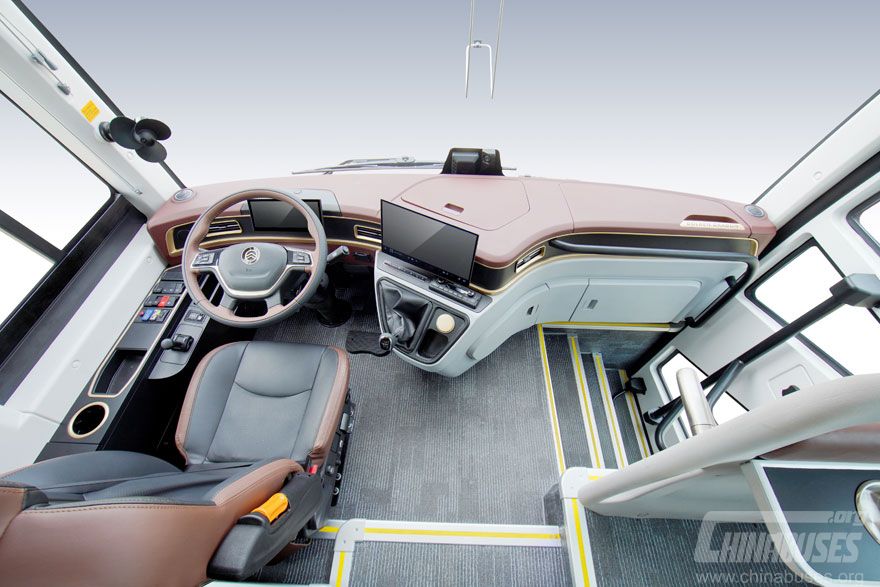
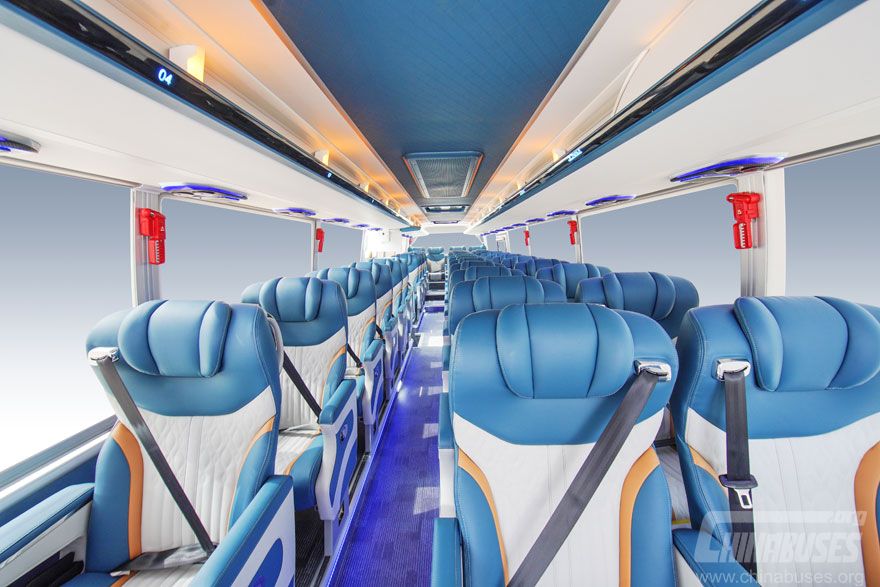
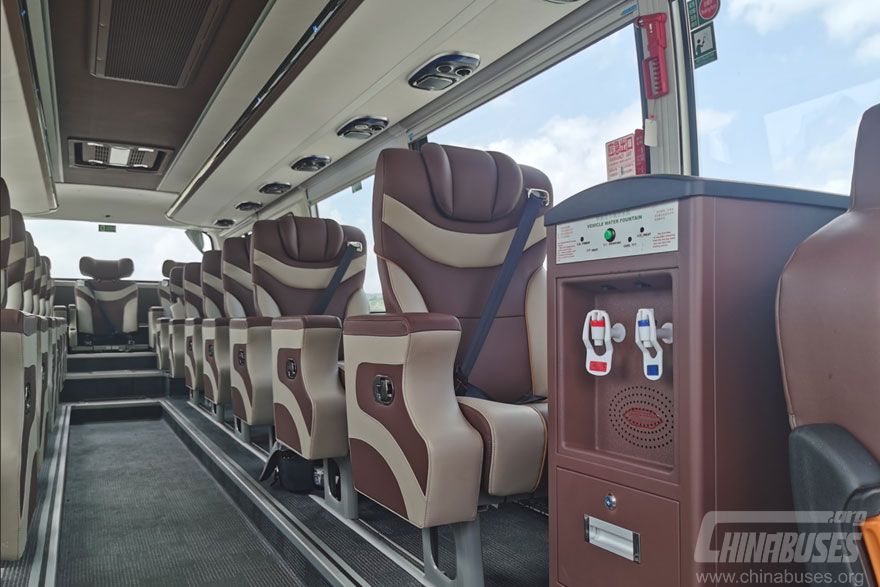
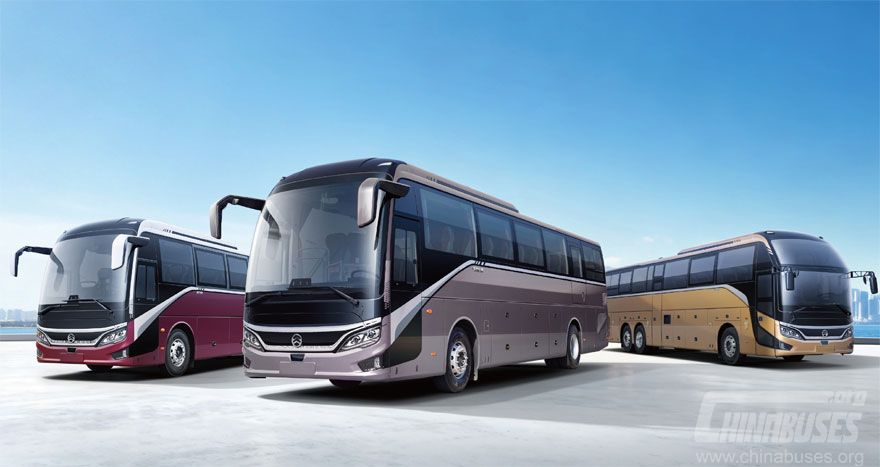
Exterior color schemes were selected from more than a thousand candidates, yielding themes such as Purple Starlight and Lake Blue Nebula; the two-tone treatment is among the first in the coach industry. The interior offers three CMF (color, material, finish) systems — Blue Realm, Gilded City and Warm Journey — transplanting passenger-car color and material logic into the coach cabin.
The exterior serves one primary design goal: bringing the drag coefficient down to 0.365. At highway speeds, aerodynamic drag accounts for more than 30% of a coach's energy consumption, and every 0.01 reduction saves roughly 0.5 kWh per 100 km for an electric coach. The low drag is not the work of any single measure but combines a "fluid sculpture" design language with peregrine-falcon-inspired biomimetic aerodynamics: the A-pillar underwent dozens of surface iterations, the body-side waistline follows the 0.618 golden ratio, and the roof-mounted air conditioner and front roof cap are fully flush-mounted — all while preserving the family-style full-width front face and star-glow light signature, converting aerodynamic refinement into measurable energy savings on operators' balance sheets.
The interior's tiered logic maps directly to operational segments. On the GC Series platform, commuting and tourism receive different levels of configuration depth: Yunnan Shunjie's 9-meter touring version adopts the "Blue Realm" theme with full soft-touch wrapping and a 2+1 business seating layout — 25 headrest-equipped business seats with adjustable backrests and a USB port at every seat — while the 8.2-meter battery-electric commuter version delivered to Hefei uses a 2+2 layout with onboard Wi-Fi and air purification to meet the efficiency and experience demands of high-frequency shuttling.
Yet on NVH — a fundamental metric — the platform makes no scenario-based compromises: the diesel model records driver-position noise below 50 dB at idle with the air conditioning off, 9.9 dB lower than the previous generation.
The recent delivery announcements make clear that customers in different regions choose the GC Series for different reasons: commuter operators value the cost certainty of RMB 0.3–0.5 per kilometer in electricity and low fuel consumption, while tourism operators value the ride quality delivered by six-airbag suspension and business seats on mountain and long-distance routes. But the platform technology and value proposition of the GC Series lie precisely here — it does not attempt to win over every scenario with a single fixed configuration, but lets the platform carry commonality while powertrain, chassis calibration and interior modules carry scenario differentiation. When a coach platform can maintain the same technical standard across 8 to 15 meters, new energy and conventional energy, and commuting and tourism, what it offers global customers is not just a coach, but an operational asset and a revenue-generating tool capable of meeting the most differentiated demands.
Source : www.chinabuses.org
Editor : Lucy
Views:5015
Share :