ACTIA Showcases New Solutions at 2026 Nanjing Transportation Expo
27 October 2026
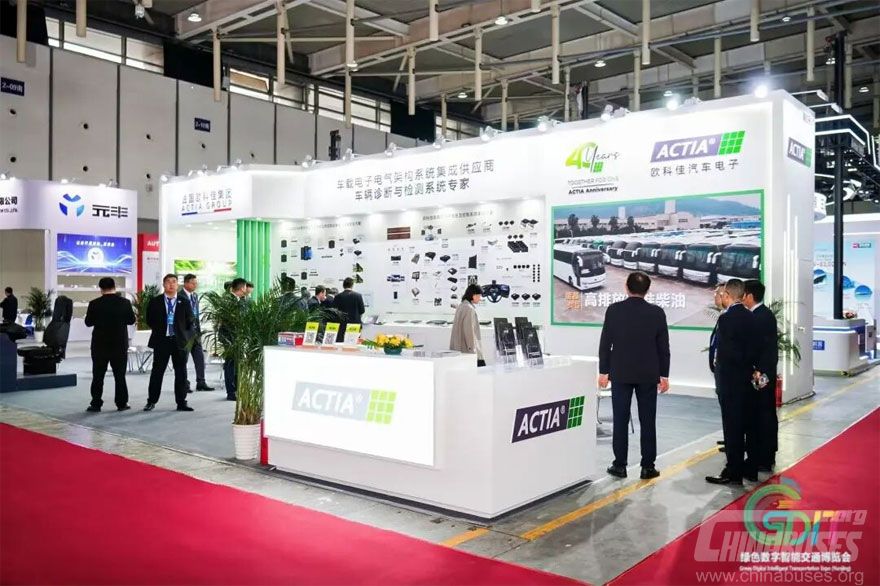
On 21 October 2026, the 2026 Green, Digital and Intelligent Transportation Expo (Nanjing) opened at the Nanjing International Expo Center under the theme "Green Innovation for Development, Digital & Intelligent Technologies Shaping the Future". As the transportation industry accelerates toward digital-intelligent integration, ACTIA (Shanghai) Automotive Electronic Equipment Co., Ltd. (ACTIA China) presented its new-generation power distribution domain controller for commercial vehicles and its brand-new SOVD diagnostic solution. Spanning from the underlying electrical/electronic architecture to upper-layer diagnostic service paradigms, ACTIA systematically addresses the core challenges facing China's commercial vehicle sector in the second half of intelligent transformation.
Dr. Zhang Xiaoping, Chairman of ACTIA China, was invited to speak at the opening ceremony. He stated that, as a component and system supplier, ACTIA supports Chinese commercial vehicle manufacturers in overcoming the standards, certification and technical barriers to entering the European market. Drawing on the ACTIA Group's long-standing expertise in European regulatory frameworks, functional safety certification and vehicle E/E architecture development, Chinese customers can align with European market access requirements at the product definition phase, reducing late-stage compliance risks and shortening overseas launch cycles. He highlighted that the deep integration of green and digital technologies is redefining the efficiency limits and safety foundation of road transport. With nearly four decades of expertise in commercial vehicle E/E architectures and vehicle diagnostics, ACTIA will continue to deliver core electronic control technologies to underpin technological upgrading and global expansion for China's commercial vehicle industry.
In the afternoon, the High-Quality Road Transport Development Forum was held. Li An, General Manager of ACTIA China, and Cao Xiaojun, Deputy General Manager of ACTIA China, delivered separate keynote launches on the power distribution domain controller and SOVD diagnostic solution, outlining ACTIA's forward-looking technology roadmap tailored to the Chinese market.

ACTIA Unveils New-Generation MPZ87 Power Distribution Domain Controller, Redefining Functional Safety
In the first launch session, Li An focused on safety and reliability challenges amid the evolution of commercial vehicle E/E architectures. He noted that controllers serve as the underlying carrier for relevant functions and the core building block of the vehicle E/E architecture as the industry advances from electrification to intelligence and then to smart mobility. While domestic controllers have formed independent technical routes for feature development, concerns remain over functional safety, including inflated output power ratings, insufficient system stability and excessive static power consumption.
To tackle these pain points, ACTIA adopts the ISO 26262 functional safety framework as its methodology. It establishes development and validation workflows around three safety objectives — output safety, system operation safety and quiescent current safety — and finalizes product specifications with innovative requirements for power distribution domain controllers in the Chinese market. The new-generation master power distribution domain controller ACTIA MPZ87 is the tangible outcome of this approach.
Integrating ISO 26262 functional safety, cybersecurity, local Chinese MCUs and high-side output chips, MPZ87 supports Ethernet and CAN FD communication, OTA upgrade and the UDS diagnostic service architecture. From chip level to system level, it reflects ACTIA's precise grasp of local supply chain security and the evolution pace of E/E architectures in China.
The UDS architecture embedded in MPZ87 enriches service capabilities at the controller level. Nevertheless, most domestic commercial vehicle E/E architectures still rely on functional networks, while service-oriented networks are yet to be established. To fill this architectural gap, ACTIA concurrently launched its new-generation SOVD solution, presented by Cao Xiaojun, extending diagnostic capabilities from individual controllers to the full vehicle level.
Compliance Starts at the Standard Source: SOVD Sets a New Diagnostic Paradigm for Software-Defined Vehicles
In the Software-Defined Vehicle (SDV) era, vehicles carry a soaring volume of software and demand permanent connectivity. Traditional UDS / DoIP / CAN diagnostic systems are essentially local, wired protocols designed for individual ECUs, which can no longer support vehicle-wide real-time services, predictive maintenance and massive data management. The industry calls for a service-oriented, remote-enabled and standardized new diagnostic paradigm — SOVD, Service-Oriented Vehicle Diagnostics.
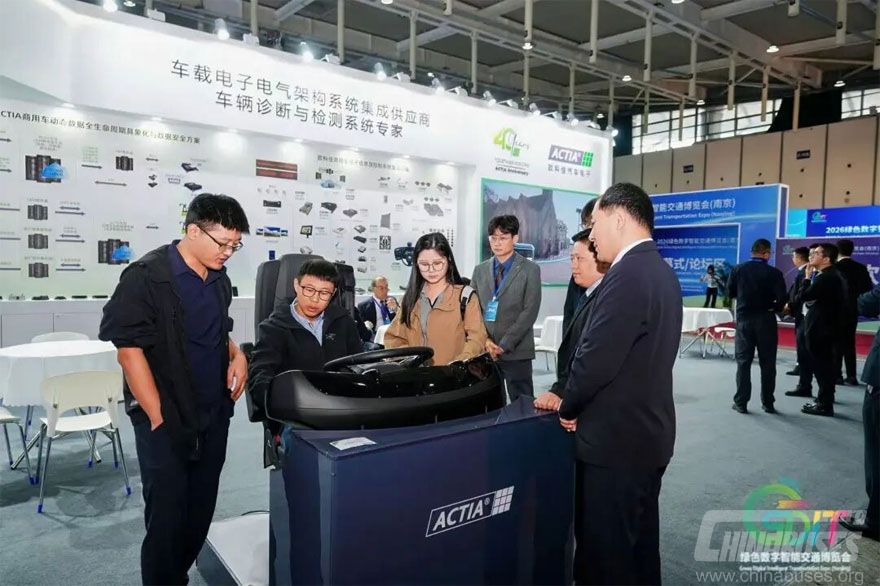
Cao Xiaojun emphasized that SOVD is not a proprietary protocol of any single company. The standard was initiated under ASAM in 2019, submitted to ISO in 2023 and published as ISO DIS 17978 in March 2025. ACTIA Group is a member of ISO WG5 and has participated in standard development since SOVD v1.1, enabling it to track standard updates promptly and guarantee built-in compliance and forward-looking design from the outset.
For OEMs, SOVD delivers multi-dimensional value: enhanced security with standardized safeguards for remote diagnostics and OTA; lower costs through reusable standard components instead of redundant development; new revenue streams by turning diagnostic data from a cost centre into monetisable service assets; and improved quality through predictive maintenance and vehicle-wide real-time services.
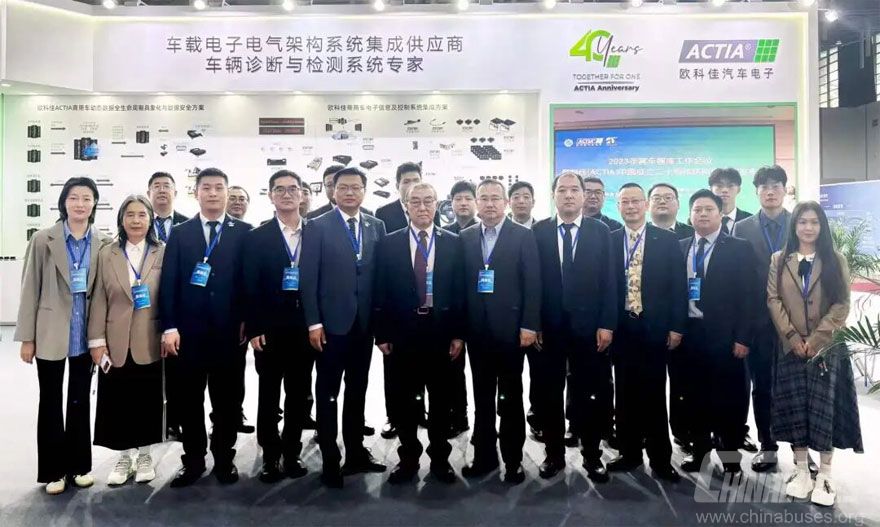
Cao Xiaojun outlined three mutually reinforcing pillars of ACTIA's diagnostic business. First, legacy and scale ensure continuity of diagnostic expertise: founded in 1986, ACTIA Group started with automotive diagnostics, posted a turnover of EUR 535 million in 2025 and reinvests 14%–17% of revenue into R&D, with more than 100,000 workshops and OEM service outlets worldwide using its diagnostic software — ranking ACTIA among the global top ten in factory and aftersales diagnostics. Second, end-to-end delivery guarantees architectural consistency: ACTIA can supply the full four-layer stack — vehicle ECUs, zone controllers and high-performance computers (HPCs), VCI and workshop tools, plus cloud backend systems — with the same core engine running consistent logic on both vehicle-side and workshop-side devices, avoiding protocol fragmentation and duplicated development caused by multi-vendor integration. Third, standard participation enables proactive compliance: as a member of ISO WG5 and ASAM, ACTIA contributes to SOVD drafting from v1.1 onward rather than adapting reactively after release, and its SOVD engine can run on platforms ranging from PCs to HPCs. Drawing on 40 years of optimisation for embedded real-time performance, ACTIA actively engages with the Eclipse open-source ecosystem, striking a verifiable balance between openness and real-time responsiveness.
Combined, these strengths position ACTIA to deliver SOVD deployments with three core advantages: compliance rooted at the standard source, consistent end-to-end delivery, and verifiable real-time performance.
Source : www.chinabuses.org
Editor : Olivia
Views:2766
Share :