Sunwin Puts Local Adaptation First as It Enters Australia’s Electric Bus Market
24 August 2026
Nearly 80% of Shanghai’s public buses are built by Sunwin Bus. Now, the Chinese commercial-vehicle manufacturer is bringing a different playbook to Australia—one built on chassis platforms, local integration, and a 20-year service-life mindset.
At the Bus & Coach Show Sydney in July, Sunwin displayed two vehicles: the iEV12, a battery-electric city bus developed for Singapore that underscores its right-hand-drive engineering and vehicle-integration capabilities; and the B13E, a 12.5-metre battery-electric bus chassis positioned as the centrepiece of its Australian entry.
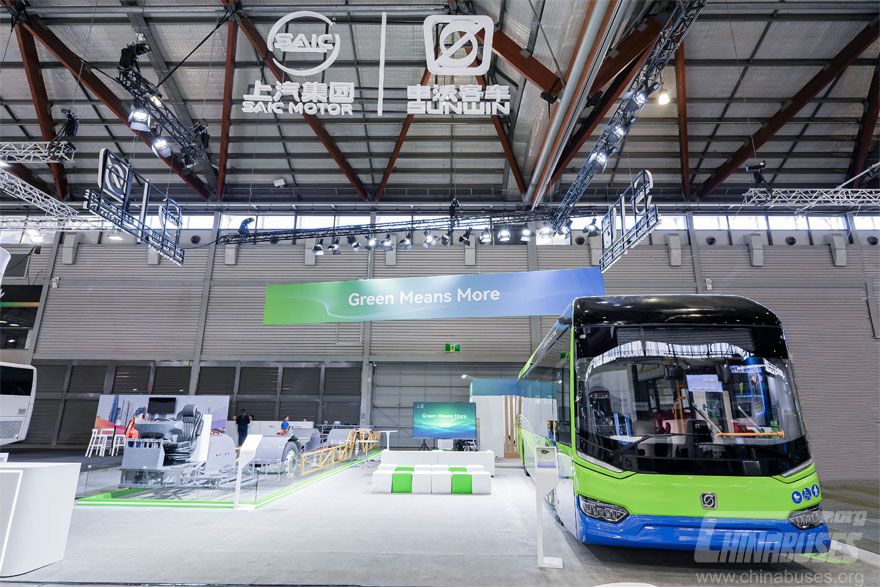
For Sunwin, entering Australia is about more than hardware. The company is pitching a full mobility solution designed to plug into local supply chains and support the region’s shift to zero-emission public transport.
An Open Platform Built for Local Rules
Australia’s public-transition momentum is creating a clear long-term opportunity. Several states have rolled out zero-emission bus programs alongside expanded charging networks, moving new-energy buses beyond pilot projects and into large-scale fleet replacements. The country replaces roughly 1,500 buses annually, about half of them for public transport—a stable and sizeable addressable market.
Yet Australia is also one of the world’s most exacting markets for bus homologation and local-content requirements. New South Wales mandates progressive local-content increases, targeting 50% by 2027. Victoria sets even higher bars for zero-emission buses, with a minimum local-content threshold of 62%. The local industry operates on a well-established division of labour: chassis suppliers provide the core powertrain and structural platform, while local bodybuilders handle assembly to state and operator specifications.
Rather than exporting complete vehicles as it does in China and other overseas markets, Sunwin has opted for a chassis-first strategy to fit into that ecosystem. The B13E chassis is designed for broad adaptability, with flexible overhang and wheelbase configurations to suit different local bodybuilders. Its platform-based scalability also accommodates varying operational standards across Australian states.
Tackling Real-World Operating Pain Points
Sunwin is not the first Chinese bus maker in Australia—several predecessors have already helped familiarise the market with electric buses. As a later entrant, the company faces a sharper question: why switch to a new brand in a mature, competitive landscape?
Rather than chasing spec-sheet battles, Sunwin’s teams conducted on-the-ground research with local operators to pinpoint differentiated opportunities rooted in operational reality. Fieldwork highlighted salt-spray corrosion from Australia’s coastal climate as a critical issue. Some in-service electric buses show structural corrosion after just six to seven years, despite a 20-year design life for local public buses. Inadequate anti-corrosion performance, the company found, is an industry-wide bottleneck.
To address this, Sunwin drew on international best practices and adopted a dual-protection approach combining chassis electrophoretic coating with targeted anti-corrosion treatments, aiming for zero structural corrosion across the full 20-year lifecycle.
Battery packaging is another optimised area. Sunwin co-developed CTP (Cell-to-Pack) batteries with CATL, achieving roughly 5% higher energy density than mainstream equivalents. Competitors often mount batteries on rooftops due to limited underfloor space on low-floor chassis, raising the centre of gravity and compromising stability. Sunwin’s low-profile cells enable flat underfloor installation, lowering the centre of gravity, improving safety, and freeing up interior space while meeting range demands for Australia’s long suburban routes.
On energy efficiency, the company has deployed self-developed, highly integrated auxiliary controllers to optimise vehicle-level energy management, cutting overall consumption by around 10% compared with similar products. That translates into longer range for the same battery capacity—and a stronger total-cost-of-ownership case.
These improvements—in corrosion resistance, battery configuration, and energy efficiency—are not about isolated spec superiority. They are engineered specifically around Australia’s need for durable, long-haul bus operations, and they form the product foundation for Sunwin’s green-mobility proposition.
After-Sales Support Before the First Delivery
Sunwin officially launched its Australia project in 2024, a decision shaped by clear market signals: state-level zero-emission policies taking effect, charging infrastructure maturing, and earlier entrants having raised end-user awareness and acceptance of electric buses.
Unlike passenger vehicles sold to individuals, public buses are typically procured in bulk by governments or transit operators. From show-floor debuts to final deliveries, programmes must navigate homologation, prototype builds, road trials, customer evaluations, product refinements, and tender processes—making business-development cycles inherently long.
In extensive client consultations, local operators consistently rank two priorities above all: vehicle reliability and rapid after-sales response. Reliability is built into product quality; responsive service requires advance preparation.
“Service networks have to be in place before formal vehicle deliveries,” said Chen Xi, Senior Overseas Product Manager at Sunwin Bus.
Starting in 2025, Sunwin’s after-sales teams have made multiple research trips to Australia, mapping operator maintenance workflows, depot layouts, and spare-parts needs. Unlike passenger-car dealer-led service models, most Australian public-transport depots maintain in-house repair workshops. Sunwin is not replicating a full passenger-vehicle sales-and-service network. Instead, it is positioning spare-parts warehouses close to key-customer depots and stationing resident after-sales engineers on-site. When faults occur, engineers travel directly to depots with required parts and work alongside in-house maintenance crews to minimise vehicle downtime.
Among Chinese automotive manufacturers expanding globally, rapid volume growth often grabs headlines. But in rule-bound, highly demanding markets like Australia, speed alone is not a competitive edge. For Sunwin, the Sydney showcase marks the starting line. What lies ahead is a sustained effort in customer validation, regulatory compliance, and continuous product iteration—building trust one bus, one depot, and one route at a time.
Source : www.chinabuses.org
Editor : Sissi
Views:20100
Share :